

| 2x / year How often do most people need a dental check-up | 2 minutes Minimum brush time, per the ADA | 90% Of gum disease cases are preventable with routine care | 47% Of US adults have some form of gum disease — CDC |
Moving to a new town means a lot of admin. New doctor, new grocery store, new everything. And somewhere on that list: a new Best Dentist in Canton, MA, your whole family can actually stick with.
Most people Google, pick whoever has decent reviews, and hope for the best. That works sometimes. Other times, you end up in an office where no one explains what they’re doing, the billing is confusing, and you leave with a treatment plan that didn’t feel right.
This guide is here to help you avoid that. We’ll walk you through what actually matters when choosing a Best Dentist in Canton, MA, what questions to ask, and give clear answers to the dental care questions people search for every day.
| The best dentist in Canton, MA, isn’t the one with the fanciest waiting room. It’s the one who makes you feel like your teeth are in good hands and does the same for your kids. |
What to Actually Look For In a Canton Dentist

A lot of advice about finding the best dentist in Canton, MA stops at ‘check credentials and read reviews.’ That’s a start. But here’s what really separates a dental practice you’ll love from one you’ll put up with.
They talk to you like an adult
Good dentists show you your X-rays. They explain what they see. They tell you your options, including what happens if you wait, without pressuring you into same-day decisions. If a dentist can’t explain a recommendation in plain language, that’s a problem worth noticing.
They’re actually good with kids
This matters more than most parents expect. A child’s early dental experiences shape how they feel about dental care for the rest of their life. A practice that’s truly good with kids doesn’t just tolerate them. They slow down. They use simpler words. They explain what’s coming before they do it. Ask specifically: ‘How do you handle anxious kids?’ A vague answer is a warning sign. A specific one is reassuring.
No surprise bills
Before any treatment beyond a routine cleaning, you should get a written estimate of what your insurance covers and what you’ll owe. If a practice won’t give you that upfront, that tells you something about how they operate.
Use this checklist when you’re evaluating a new practice:
| Non-negotiable | What separates good from great |
| Licensed in Massachusetts | Accepts your insurance plan |
| Sees kids and adults comfortably | Uses digital X-rays |
| Gives upfront cost estimates | Has evening or weekend hours |
| Strong, recent Google reviews | Explains treatment before starting |
| Has sedation for anxious patients | Handles dental emergencies |
| Clean, well-kept office | Listens when you talk |
How to Find a Great Best Dentist in Canton, MA – Step By Step

Searching for a Best Dentist in Canton, MA gives you options. Here’s how to sort through them without wasting time on dead ends.
Start with your insurance, don’t stop there
Your insurer’s site will show in-network providers near Canton. That’s a useful first filter; out-of-network costs add up. But in-network just means the billing is simpler. It doesn’t mean the dentist is good. Use that list as your starting point, then evaluate from there.
Read reviews like a detective
A 4.8-star average across 200 reviews is a good sign. But read the 3-star reviews; they’re usually the most honest. Look for patterns. Are multiple people mentioning the same billing issue? Long waits? Communication problems? One complaint might be a bad day. Five of the same complaints are a pattern.
Also, check how the practice responds to negative reviews. Defensive replies tell you one thing. Thoughtful, genuine replies tell you something much better.
Call before you book
Don’t just click ‘Book Online.’ A quick phone call tells you a lot. Did someone answer? Were they friendly when you asked about insurance? Did they volunteer information or make you drag it out of them? How a practice handles new patient calls is usually how they handle patients, full stop.
When you call, ask about:
• New patient wait times; a busy practice is often a good sign
• Whether they take your specific insurance plan
• How they handle anxious patients, if that applies
• Whether they have emergency same-day slots
Ask your neighbors
Canton is a close-knit community. Local Facebook and school pickup discussions, neighborhood app, these are really helpful. The advice of a person in a comparable situation to yours is usually more valuable than any review site.
Treat the first visit as a test
You are not committed since you presented yourself once. Take note of wait times, the way the dentist in Canton, MA, communicates with you, the cleanliness of the office, and whether you felt listened to. There is nothing wrong with not going back. Good practices make you a repeat customer.
What should a good Canton family dentist offer?

A solid dentist in Canton, MA, should handle your whole family’s needs without sending you to three different offices. Here’s what a full-service practice looks like:
| Preventive | Cosmetic | Restorative & Specialty |
| Cleanings & exams | Teeth whitening | Dental implants |
| Digital X-rays | Porcelain veneers | Invisalign |
| Tooth-colored fillings | Crowns & bridges | Gum disease treatment |
| Children’s dentistry | Tooth extractions | Sedation options |
| Emergency dental care | Night guards / TMJ | Oral cancer screening |
Not every dentist does everything on that list, and that’s fine. Experts are there because there is a reason. Preventive, basic restorative, and cosmetic needs, however, should be covered by your main dentist, and when you require more, there should be specific and trusted referrals.
The 2-2-2 Rule, 3-3-3 Rule, and 2-Year Rule – Plainly Explained

These come up a lot in dental content. Here’s what they actually mean and which one is right for you.
| Rule | Part one | Part two | What it means for you |
| 3-3-3 Rule | Brush 3x a day | 3 minutes per session | Every 3 months – high-risk patients only |
| 2-2-2 Rule | Brush 2x a day | 2 minutes each time | Every 6 months – right for most people |
| 2-Year Rule | Max gap between visits | Even if you feel fine | Problems hide. Don’t wait this long. |
Which one applies to you?
The 2-2-2 rule is the target of most healthy adults and children. Brush your teeth twice a day, two minutes at a time, and visit your dentist twice a year. This has been supported by the ADA for decades, and the results always favor those who do not have active dental disease.
The 3-3-3 rule is stricter- applied to individuals at greater risk, such as individuals with active gum disease, diabetes, dry mouth, or individuals with a history of frequent cavities. When your dentist suggests a visit every three months, it is not upselling. It is normally a clinical cause. Ask them to explain it.
The hard floor is the 2-year rule. Although you may be okay and your teeth may seem beautiful, it is not safe to skip a professional checkup every two years. Early gum disease and cavities have no symptoms. Early preventive treatment means filling rather than root canal, cleaning rather than surgery.
Morning or Night – When Should You Brush?
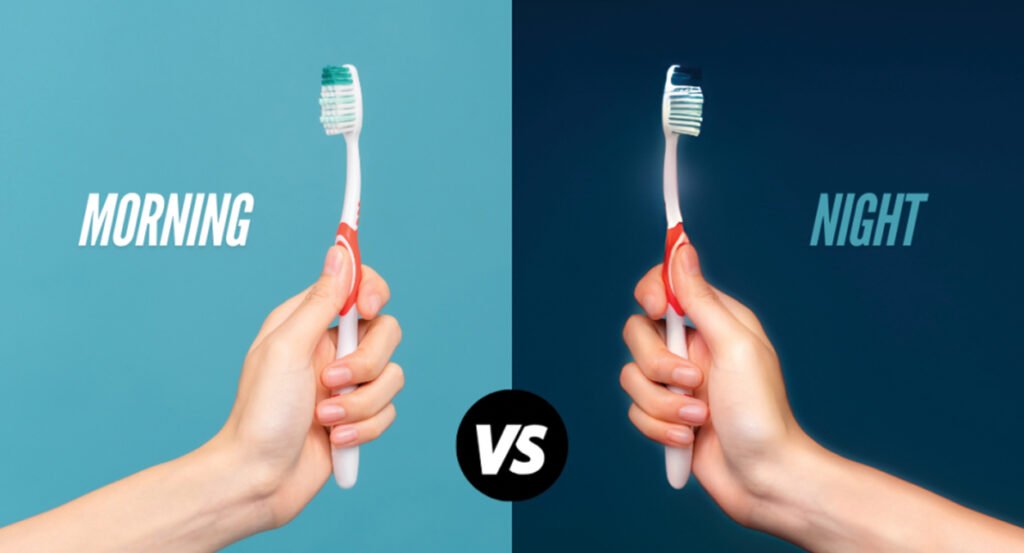
Both. However, when forced to choose, dentists would say: ” Brush at night.
Throughout the day, saliva keeps the bacteria at bay – rinsing your mouth, acid-neutralizing, and slowing down decay. Salivation decreases drastically at night. Bacteria that are on your teeth have hours of continuous time to damage them. Brushing at night will remove the food and plaque that feeds the process.
It does not matter whether one brushes in the morning. It gets the stuff out of the way that accumulated overnight and gets your lungs clean. Both meetings are justified. But the one that should not be skipped is the night one.
| A common mistake worth knowing Do not brush immediately after a meal- particularly after coffee, juice, soda or wine. The enamel is softened temporarily by the acid in those foods. Washing it when it is soft brushes it away. Wait 30 minutes. Rinse with water in the meantime. |
What Your First Appointment with a Dentist in Canton, MA will Look Like

New patient examination typically takes between 60 and 90 minutes. Otherwise, not having previous records to move, it will be on the longer side. The following is covered by that time:
- Health history: drugs, allergies, previous dental treatment, anything you are concerned about. Be honest. Information such as blood thinners and anxiety influences the way your care is planned.
- X-rays: Most of the current practices use digital X-rays. They need minimal radiation as compared to ancient film X-rays and display results on screen.
- Clinical exam- all teeth, gums, bite, jaw joint, and soft tissue examination, including oral cancer screening. More detailed than the first-timers want.
- Cleaning: In case there is no severe gum disease, a hygienist will remove tartar and polish your teeth. In case of gum disease, a deeper cleaning is booked separately.
- Review of treatment: In case something needs to be done, the dentist takes you through it, showing you the X-rays and photos so that you can see what they see. An effective practice provides you with choices and time to make inquiries.
You must walk away knowing just where the health of your teeth is, what needs to be done, and how much it will cost you. If you walk away bewildered, or even thinking that decisions were made without you, listen.
A quick word on kids and Best Dentist in Canton, MA

The American Academy of Pediatric Dentistry suggests a first dental appointment at the age of one year old, or within six months of the first tooth eruption. The initial appointment is primarily a familiarization visit where you have your child acquainted with the procedure, and if that development seems to be fine, they provide you with advice on how to take care of small teeth at home.
The pediatric question is important when selecting a dentist near me that you can take your family to. Observe the way employees treat the children in the waiting area. Enquire about the way the hygienist treats young children. A work environment that really enjoys dealing with children is different as soon as you enter.
- First visit: 1 year of age, or 6 months after the first tooth.
- Regular examinations: after 6 months.
- Begin to floss when two teeth come into contact.
- First X-rays: typically between 4 and 6 years of age.
- Sealants: usually prescribed between ages 6 and 7 for permanent molars.
Children who receive good early dental experiences become adults who attend their appointments. It is worth starting out properly.
| Ready to find the best dentist in Canton that your family can trust? Allure Dental serves families and new Canton residents with straightforward, patient-first care. No pressure. No surprise bills. Easy to get started. Book your appointment |
FAQs
Q: What is the 3-3-3 rule about teeth?
Brush 3 times daily, 3 minutes twice a day, and come to the dentist every 3 months. It is used in more risky patients – individuals with active periodontal disease, diabetic patients, dry mouth, and those who have had frequent cavities. Should your dentist prescribe this and you are not aware of the reason why, ask him/her to clarify to you why he says that it is necessary.
Q: What is the best dentist in your neighborhood?
Start with a filter of your insurance network. Always read reviews critically – find patterns, not star ratings. Prior to booking, call the two or three best practices. Book another appointment with the patient and see what happens. Request real suggestions from the neighbors. The most suitable dentist in Canton, MA that your family will have is the one that you trust – and this will require you to visit a few times before you get to trust.
Q: What is the 2-year rule of a dentist?
The length of time between dental check-ups should not exceed two years. There is a myriad of severe dental issues, such as early cavities, gum disease, and oral cancer, and they all occur without any kind of symptom you could point to. More than two years of a professional examination-free life means that minor, easily manageable issues will have time to grow into larger, more costly ones.
Q: What is the 2-2-2 rule of teeth?
Brush twice a day, two-minute intervals, and visit your dentist twice a year. This is advised in the ADA for the majority of both adults and children. Together with regular flossing, it helps to avoid the vast majority of prevalent dental issues. So easy I can do it in everyday life, that is the entire point.
Q: Which is more convenient to brush your teeth in the morning or at night?
Both. But which would you have first, brushing at night? When you sleep, the production of saliva reduces, and bacteria have more time to act on your teeth. Brushing at night carries away what would otherwise be accumulated there all night. Brushing in the morning will remove any accumulation that has been in the mouth overnight and aid in breathing. You must not miss the night one.